WELCOME TO PNG INSIGHT

Reviewing IMF 9 Structural Benchmarks and Performance Criteria for PNG

A Review of the Statement by Robert Nicholl, IMF Executive Director for Papua New Guinea and Rhoda Karl, IMF Advisor to Executive Director [International Monetary Fund, Asia and Pacific Dept, Country Report No. 23/126, published 29 March 2023]

Download the full report, click here (PDF, 1.7MB)


Introduction

On March 22, 2023, Robert Nicholl, the IMF Executive Director for Papua New Guinea, and Rhoda Karl, Advisor to Executive Director, released a statement that outlines the economic conditions in Papua New Guinea (PNG).

The statement addresses the progress PNG makes in meeting its quantitative and structural benchmarks, and its commitment to continue its economic reforms. 

This article provides an overview of the statement, highlights the nine Structural Benchmarks (SBs) and several Quantitative Performance Criteria (QPC) and indicative targets set by the authorities, and outlines the main ideas presented in the statement.
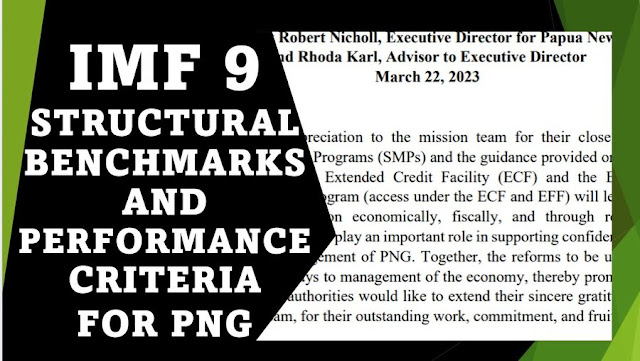
Reviewing PNG's Economic Progress: IMF's Structural Benchmarks and Performance Criteria


Overview of PNG

PNG is one of the most culturally diverse countries in the world with over 800 different languages spoken among its nine million people. 

However, much of the country is covered with rugged mountains and swamps, and access to government services and the formal economy remains a challenge for most of the population. 

The vulnerability to climate change and frequent natural disasters presents additional challenges to the country's economic development.


Economic Conditions

The PNG economy is on course to register a strong growth of 4.5 percent in 2022, driven by a strong recovery in the non-resource sector. 

Growth is expected to moderate to 3.7 percent in 2023 and converges to potential over the medium term, driven by higher private investment and the government’s public investment program. 

Inflation accelerated to 6.6 percent in 2022, but authorities used fiscal and monetary policy instruments to cushion the impact on the cost of living and anchor inflation expectations. 

The risks to the outlook for PNG are tilted to the downside due to weaker external demand, tighter global financial conditions, and climate-related natural disasters.


Structural Benchmarks and Quantitative Performance Criteria

The PNG authorities have committed to achieving nine Structural Benchmarks (SBs) and several Quantitative Performance Criteria (QPC) and indicative targets. 

The SBs include 

  1. improving public financial management, 
  2. implementing a fiscal responsibility law, 
  3. improving the governance and performance of State-Owned Enterprises, 
  4. strengthening monetary policy and exchange rate frameworks, 
  5. improving the supervision of banks and non-bank financial institutions, 
  6. improving access to finance for SMEs, 
  7. improving data quality and compilation, 
  8. enhancing revenue administration, and 
  9. addressing the systemic and systematic corruption in PNG public service.
The QPCs and indicative targets include 

  • fiscal consolidation, 
  • revenue collection, 
  • public debt management, 
  • inflation, 
  • international reserves, and 
  • the balance of payments.


Blended ECF/EFF Financing Program

The financing program builds on the policy objectives of the last Staff Monitored Programs (SMP 2019 & SMP 2022). The IMF-monitored programs were to 

  • progress further reforms to budget repair and fiscal consolidation, 
  • improve governance, and 
  • strengthen the monetary policy and exchange rate policy frameworks while addressing the prospective balance of payments needs. 

The program aims to leave PNG in a much stronger position economically, fiscally, and through reduced debt exposure.


Conclusion

In closure, the statement by Robert Nicholl, Executive Director for Papua New Guinea, and Rhoda Karl, Advisor to Executive Director, highlights the progress made by PNG in meeting its quantitative and structural benchmarks and its commitment to continue its economic reforms. 

The nine SBs and QPCs outlined in the statement provide a roadmap for PNG's economic development, and the financing program aims to leave the country in a much stronger position economically and fiscally. 

Despite the downside risks, the potential for significantly larger LNG revenues and the commencement of new extractive projects offer notable upside risks over the medium term.


Read about the Pros and Cons of the IMF Loan, click here on the IMAGE.

pros and cons of IMF loans PNG government should know


IMF Push Reforms in PNG with $918 million Short and Long Term Loans

The International Monetary Fund (IMF) has approved a 38-month Extended Credit Facility (ECF) and Extended Fund Facility (EFF) for Papua New Guinea (PNG) in the amount of SDR684.3 million, equivalent to $918 million, to address the economic impacts of multiple shocks, including low commodity prices, drought, earthquakes, and the COVID-19 pandemic.

See the definitions of ECF and EFF at the end of this article.

pros anc cons of IMF loans to PNG 2023 - 2024


Reforms

The program aims to protect vulnerable groups and promote inclusive growth through debt sustainability, foreign exchange (FX) shortage alleviation, and enhanced governance and anti-corruption efforts. 

The IMF believes that the program will support and enhance PNG's credibility and improve its access to international financial markets.

What is not clear is what 'exactly' is/are changing and how the changes will affect the institutions and the people they serve.


Key Rates

The IMF loan will be subject to a 2.4% interest rate, lower than the current weighted average interest rate for external loans (2.8%) and domestic loans (7.2%). 

Repayment will be over a ten-year period, with a 5.5-year grace period.

It may seem like a good deal, but a loan is a loan. And, an IMF loan that comes with institutional reformations and conditions has a lot to be desired. 

If it sounds too good to be true, it probably is.


Pros and Cons of the IMF loans

Pros:

  • The loan will provide much-needed financial support to the PNG government and enhance its credibility.
  • The loan will help repair public finances and alleviate pressure on government spending.
  • Priority areas for capital expenditure in the 2023 budget include transport, utilities, education and health.
  • The IMF's support will improve PNG's access to international financial markets.


Cons:

  • Phased disbursement of the loan will be conditional on progress against benchmarks that are yet to be made public. (This is IMF's secret weapon, it can do what it thinks is best, and as it pleases - not good for PNG.)
  • The IMF will seek exchange-rate liberalisation, financial-sector deepening, and state-owned enterprise (SOE) reform under the new program, which may not align with recent steps taken by PNG to protect local industries through higher tariffs and ad hoc tax increases. This will be forced upon the PNG government whether it likes it or not!
  • The loan does not significantly change risk around PNG's debt profile, which stands at K48.3bn.
  • Continued policy reforms and international support are needed to address PNG's vulnerability to domestic and external shocks. (The details of the reforms are not clear)


Read about the 9 structural benchmarks that IMF is setting for PNG, Click Here.
Read about the 9 structural benchmarks that IMF is setting for PNG


IMF Push Reforms

The IMF's approval of the ECF and EFF is a significant development for PNG, but policy reforms and international support are still needed to address the country's vulnerability to economic shocks. 

While the loan's generous terms will help to contain repayment risk, the government must prioritize debt sustainability and FX shortage alleviation to address PNG's most pressing challenges.


Extended Credit Facility (ECF) and Extended Fund Facility (EFF) 

Notes on: ''The International Monetary Fund has approved a 38-month Extended Credit Facility (ECF) and Extended Fund Facility (EFF) for Papua New Guinea ''

The ECF and EFF are both lending arrangements that provide financial assistance to countries facing balance of payments difficulties. The ECF is a medium-term lending facility, while the EFF is a longer-term lending facility.

The ECF for PNG is designed to provide financial support to the country over a period of 38 months, while the EFF provides support over a longer period of time. The purpose of both facilities is to help PNG address its economic challenges while also implementing necessary structural reforms that can promote sustained economic growth and development.

The recent purported IMF debt facilities are a blended model pegged to 38 months and a further 10 years depending on IMF's ongoing situation analysis.

The policy conditions attached to both facilities include measures to strengthen public financial management, enhance revenue mobilization, improve the business climate, and address governance challenges. These reforms are intended to help restore macroeconomic stability and promote sustained economic growth and development in PNG.

The approval of both the ECF and EFF programs are conditional on IMF reforms in Papua New Guinea.

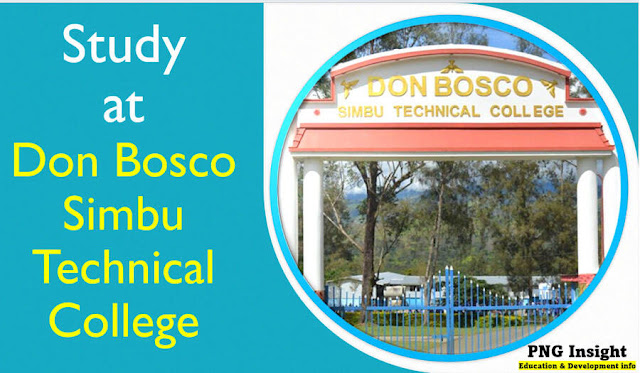
Study at Don Bosco Simbu Technical College in 2026

Don Bosco Simbu Technical College, renowned for its exceptional academic programs, experienced faculty, and cutting-edge facilities, offers a wide range of courses to prepare students for successful careers in various technical fields. 

Whether you aspire to become a skilled carpenter, welder, automotive technician, or pursue a business-related career, this college provides the ideal institution to acquire practical skills and knowledge that will propel you toward a career in the technical-skill sector.


The Grade 12 School Leavers ONLINE Selection started in 2018. It is the best thing that happens. The online selection helps DHERST, the government and stakeholders know exactly how many Grade 12 students are selected for universities and colleges. 

In a recent media statement, DHERST also resorted to bringing the NON-SCHOOL LEAVERS Selection ONLINE. Universities and colleges are not going to make the selections. So, what does that mean for you as a non-school leaver applicant? Find out here


Courses Offered

Don Bosco Simbu Technical College offers the following courses:

1. Carpentry and Construction

2. Metal Fabrication and Welding

3. Diploma and Certificate in Automotive Technology

4. Diploma and Certificate in Electrotechnology

5. Diploma in Maintenance Fitting and Machining

6. Business Studies in Accounting

7. Business Studies in Management


Eligibility

To apply for the certificate courses, you should have a minimum Grade 10 qualification without any failing marks. 

For diploma and business courses, a Grade 12 qualification is required. Additionally, a good Grade Point Average (GPA) of 2.0 and above is expected.

For self-sponsored students, please contact the college for more information via the phone number and email provided below.

Don Bosco Simbu Technical College Application Form PDF download and Contacts


How to Apply as a Non-School Leaver

If you are a non-school leaver, applying for admission to Don Bosco Simbu Technical College is a straightforward process. The college is run by the Catholic Mission and they are pretty effective when it comes to getting questions answered.

Simply contact the college to request an application form. 

You can reach out to the college administration by calling the following numbers: 7955 5665 or 7330 2768. 

Alternatively, you can send an email to dbsimbutc@gmail.com. The college will provide you with the necessary application form and guide you through the application process.


How to Apply as a Grade 12 School Leaver

Each year, Don Bosco Simbu Technical College take in 140 Grade 12 intake, half of which are female students, from all over the country. Check out the 2025 selection list showing this data and data for other technical colleges in PNG.

For Grade 12 school leavers, the application process is conducted through the Department of Higher Education, Research, Science, and Technology (DHERST) online application system. 

Visit the DHERST website and follow the instructions to complete the online application form. 

Make sure to select Don Bosco Simbu Technical College as your preferred institution during the application process. After submitting your application, you must do well in the Grade 12 examinations to be selected via the DHERST online selection for 2026.


Don Bosco Simbu Technical College

The Don Bosco Simbu Technical College is the ideal choice for students aspiring to pursue technical courses and embark on a rewarding career path. 

Don't miss out on this chance to shape your future! 

For more information and any queries you may have, please contact the college administration at the following numbers: 7955 5665 or 7330 2768, or email dbsimbutc@gmail.com.

Leave a comment below if you have further questions about how to apply to Don Bosco Simbu Technical College.

How to Check NASFUND Balance on Mobile Phone Using 627

As a NASFUND member, it's essential to keep track of your superannuation balance to plan for your future retirement. One of the easiest ways to do this is through your mobile phone. NASFUND has introduced a convenient way for members to access their account balances using their mobile phones through a USSD code, 627. 

In this article, we will guide you through the process of checking your NASFUND balance on your mobile phone using 627.


Step-by-Step Guide to Checking Your NASFUND Balance using 627

  • Dial *627# on your mobile phone's dial pad.
  • Press the 'call' or 'send' button to initiate the USSD code.
  • You will be prompted to enter your NASFUND membership number. Type in your membership number and press 'send'.
  • You will be asked to enter your date of birth in the format of DDMMYYYY. For example, if your date of birth is 1st January 1990, you would enter 01011990. Press 'send'.
Alternatively, you can initiate the 4 steps in one go as shown in the video:


The USSD code will then display your current NASFUND balance on your mobile phone screen.

A network fee of 10t will be charged to your phone.


Important Notes to Remember

You must have a mobile phone that is compatible with USSD codes and has an active connection to use this service.

Make sure that you have a sufficient credit balance on your mobile phone to avoid any issues with the transaction.

The USSD code service is available 24/7, but standard network charges may apply.

If you encounter any difficulties while checking your NASFUND balance using 627, you can contact the NASFUND Members Office for assistance.


NASFUND Balance Check

Checking your NASFUND balance using your mobile phone is a quick and convenient way to keep track of your superannuation savings. 

The USSD code service provided by NASFUND is easy to use and can be accessed from anywhere and at any time. By following the step-by-step guide outlined in this article, you can check your NASFUND balance on your mobile phone using 627.

 It's essential to keep track of your NASFUND balance regularly to ensure that you are on track towards achieving your retirement goals.

POST A COMMENT.

SEARCH THE ENTIRE SITE HERE

Public Holidays in PNG 2025

Public Holidays in PNG 2025
CLICK ON THE IMAGE TO GET THE LATEST INFORMATION