WELCOME TO PNG INSIGHT

Grade 9 selection list for 2026 MOMASE Region

The Grade 9 selection process is an important step in the education journey of students in the Momase Region. This process is based on the student’s performance in both internal and external assessments. In this article, PNG Insight takes a look at how to check the Grade 9 selection list for 2026 MOMASE region, and the important details about the selection students, parents and citizens should know.


Grade 8 Internal Assessments

Internal assessments are conducted by the school. These assessments measure the student’s progress throughout the year and provide valuable feedback to the student and their parents. 

The following subjects are assessed internally:

  • English
  • Mathematics
  • Combined Subjects

Grade 9 Selection List for 2025 MOMASE Region PDF download


Grade 8 Exam Marks - External Assessments

External assessments are administered by the National Department of Education as the Grade 8 Examinations. These assessments measure the student’s aptitude and skills in preparation for secondary school.

The Grade 8 Examination is a nationwide assessment that covers a wide range of topics. The exam consists of three papers: English, Mathematics, and Combined Subjects. Each paper is worth 50 marks.


Selection Criteria for Grade 9 Selection 2026 MOMASE Region

The selection criteria for Grade 9 are as follows. Students must:

  • meet the minimum requirements in both internal and external assessments.
  • be in good standing with the school and have no disciplinary issues.
  • demonstrate strong leadership qualities and be able to work collaboratively.

Parents and guardians should know that the availability of spaces in some of the top secondary schools in the provinces may mean that only the top students are selected to continue Grade 9. 

If you wish for your child to do FODE, check out the information here.


How Parents Can Find Out

Parents can find out if their child has been selected for Grade 9 by checking the provincial education office notice board. The notice board will display the Grade 9 selection list for the MOMASE Region.

The Grade 8 Certificate of Basic Education Examination (CoBEE) is an important award that should be given to every Grade 9 student. The CoBEE is a recognition of the student’s achievement in completing eight years of primary education. It is also a requirement for admission to secondary school.

Provincial Education Boards should prioritise issuing the CoBEE to Grade 8 school leavers. This will ensure that all students have a record of their accomplishments and are prepared for the next stage in their education.


Facts about Grade 9 Selection You Should Know

The Grade 9 Selection List for the 2026 Momase Region is the responsibility of the provincial education officials in Morobe, Madang and Sepik Provinces. 

The National Education Department is responsible for the development of the Grade 8 examination, but its administration and the selection of students for Grade 9 are the responsibility of the provincial education authorities. 

The best people to check the Grade 9 Selection List for 2025 Momase Region are the:

  • Grade 8 Provincial Examination Supervisor (PES), 
  • Guidance Officer, 
  • School Inspector, and
  • the Principals of secondary schools and the Head Teachers of high schools.

Grade 9 selection list PDF 2024 MOMASE download
The Grade 8 Certificate of Basic Education Examination (CoBEE) is an important award that all Grade 9 students should receive.


Final words

The Grade 9 Selection List for the 2026 Momase Region is the responsibility of the Provincial Education Office. Grade 8 students must meet the minimum requirements in both internal and external assessments to be selected for Grade 9. 

Students can find out their selection status by checking the provincial education office notice board. 

The Grade 8 Certificate of Basic Education Examination (CoBEE) is an important award that all Grade 9 students should receive.

PNG Grade 12 Selection List and DHERST Launching Vs Publication DATES for 2025 School Year

The Department of Higher Education, Research, Science, and Technology (DHERST) Online application system (NOAS) dates for the 2025 academic year have been released in NOAS Press Statement #2/2024. Students and schools should be aware of the dates between now and when the 2025 academic year admission selection list comes out.

Grade 12 students need to mark these dates in their calendars and start planning ahead. When the time comes, they can adjust their NOAS applications early in anticipation of the selection for 2025.

Updated Important Dates for 2024 Selections

  • Release of Exam Results: 5th December 2024
  • NOAS Grace Period: Commences on Monday, 9th December 2024 at 12:01am and ends on Saturday, 14th December 2024 at 11:59pm
  • Launching (Selection Day) of 2024 Selection for 2025 Academic Year: Wednesday, 18th December 2024
  • Admission Selection List Publication: Date not announced yet (last year's publication was on Saturday, 23rd December 2023)

Find out the key dates and important info about https //apply.dherst.gov.pg login login account

Here is an article about why it is important to get your choices on the NOAS online application right.

DHERST NOAS Online - 2024 Key Dates (UPDATED)

Here are the key dates in reverse order:
  • 2025 academic year admission selection list publication – NOT ANNOUNCED, but here is last year's publication date - Saturday 23rd December 2023
  •  Launching (SELECTION DAY) of 2024 Selection for 2025 academic year - WEDNESDAY 18th December 2024
  • NOAS Grace period – commences on MONDAY 9th December 12:01am - and ends on SATURDAY 14th December, 11:59pm.
  • Release of EXAM Results 5th DECEMBER 2024
  • Grade 12 National Examination – October 14th - 18th, 2024. (DONE)
  • NOAS application period begins – All Grade 12 students should have now obtained their National Online Application (NOAS) credentials from the school principal and patrons (ONGOING)

Click here to read more about the 2024 Grade 12 Selection Launching Date & Publication Date.

What to Do During the Grade Period?


Important Update for Grade 12 School Leavers for 2024 applying to the HEIs for the 2025 academic year. The Grace Period for submitting your Higher Education program choices is only 5 days - commences on FRIDAY 2nd December 12:01am - and ends on FRIDAY 5th December, 11:59pm.
  • Check for RED lights: If any of your choices have a RED light, it means you didn't meet the minimum program requirements. Replace those choices with eligible programs.
  • No RED lights: If you don't see any RED lights, you meet the minimum requirements for your chosen programs.
  • Unused programs: Any programs you didn't meet the requirements for will be removed from your account.
  • National Online Selections: The DHERST Minister will launch the online selection process on the 16th of December, 2024.
  • Take Action: Use this extended Grace Period to review your choices carefully and ensure they align with your education goals and academic performance.

Grace period for NOAS

The grace period is a brief window after the Grade 12 students get their 2024 National Examination Results. It is an ideal time when students can adjust their school leavers choices on the NOAS application online.

For the Grade 12 students, this is a valuable chance to review your 2024 exam performance and other new information in the NOAS, and to make any necessary changes to improve your odds of being accepted into your preferred institution and program.

Papua New Guinea's GDP per capita: Trends, composition, challenges, and prospects

Papua New Guinea is a lower-middle-income country with a GDP per capita of *$2,708 in 2022. While this is lower than the global average, Papua New Guinea's GDP per capita has been growing steadily in recent years. The mining sector is the largest contributor to the economy, followed by agriculture, forestry, and fishing. However, the country faces a number of challenges to further development, including a large informal sector, high levels of poverty and inequality, limited access to basic services, poor infrastructure, and a challenging business environment. Despite these challenges, Papua New Guinea has the potential to achieve strong economic growth in the coming years. Policymakers can focus on promoting economic diversification, investing in infrastructure and social services, improving the business environment, and reducing poverty and inequality to boost GDP per capita and create a brighter future for all Papua New Guineans.


*The World Bank classifies countries as lower-middle-income if their GDP per capita is between $1,046 and $4,095. Papua New Guinea's GDP per capita of $2,708 is therefore in the lower end of the range for lower-middle-income countries.

Papua New Guinea's GDP per capita
The PNG LNG project has had a significant impact on Papua New Guinea's GDP per capita, boosting it by an average of 1.5% per year since 2014. It has also created jobs and reduced poverty, although this impact was largely evident during the development phase. Since then, the project has not generated as many new jobs or opportunities, but it has continued to generate tax revenue for the government.


Introduction

Gross domestic product (GDP) per capita is a measure of economic well-being. It is calculated by dividing the total value of all goods and services produced in a country (GDP) by the population. GDP per capita is often used to compare the living standards of different countries.

Papua New Guinea is a lower-middle-income country with a GDP per capita of $2,708 in 2022 (World Bank). This is lower than the global average of $12,241. However, Papua New Guinea's GDP per capita has grown by an average of 2.5% per year over the past decade.


Trends

The growth of Papua New Guinea's GDP per capita has been driven by a number of factors, including strong growth in the mining and construction sectors, as well as an increase in government spending on infrastructure and social services. The mining sector is the largest contributor to the economy, accounting for around 20% of total output. The other main sectors of the economy are agriculture, forestry, and fishing (16%), construction (12%), and wholesale and retail trade (11%).

Papua New Guinea's GDP per capita comparison


Composition

Papua New Guinea's economy is heavily dependent on the mining and oil and gas sectors. This makes the economy vulnerable to fluctuations in commodity prices. The government is working to diversify the economy and reduce its reliance on mining. However, this process will take time.

In addition to mining, Papua New Guinea has a significant agricultural sector. Agriculture employs around 80% of the population and contributes around 16% to GDP. However, agricultural productivity is low and many farmers live in poverty. The government is working to improve agricultural productivity and support farmers through programs such as the Special Agriculture and Business Lease (SABL) program.

The government is working to improve agricultural productivity and support farmers through programs such as the Special Agriculture and Business Lease (SABL) program.
Logging Special Agriculture and Business Lease (SABL) areas


Challenges

Despite recent economic growth, Papua New Guinea faces a number of challenges to further development. These challenges include:


  • A large informal sector, which is estimated to account for over 80% of the economy.
  • Limited access to basic services such as education and healthcare.
  • High level of systemic and sytematic corruption.
  • A challenging business environment.
  • High levels of poverty and inequality.
  • Poor infrastructure.

The informal sector is a major challenge for the Papua New Guinean economy. It is difficult to tax and regulate the informal sector, which limits the government's ability to raise revenue and provide services. The informal sector also deprives workers of important benefits such as social security and minimum wages.

High level of systemic and sytematic corruption


Poverty and inequality

Poverty and inequality are also major challenges for Papua New Guinea. According to the World Bank, around 40% of the population lives below the national poverty line. Inequality is also high, with the richest 10% of the population earning more than 40% of the country's income.

Papua New Guinea also faces a number of challenges in terms of access to basic services. The country has a high illiteracy rate and many people lack access to healthcare. Infrastructure is also poor, with many roads and bridges in need of repair.

Finally, the business environment in Papua New Guinea is challenging. The country has a complex regulatory environment and corruption is a problem. This makes it difficult for businesses to operate and invest in the country.


Prospects

Despite the challenges listed above, Papua New Guinea has the potential to achieve strong economic growth in the coming years. The country has a wealth of natural resources, a young and growing population, and a government that is committed to economic reform. If the government can successfully address the challenges listed above, Papua New Guinea can achieve significant progress in terms of economic growth and poverty reduction.


Conclusion

Papua New Guinea has made significant progress in recent years in terms of economic growth and poverty reduction. However, the country still faces a number of challenges, including a large informal sector, high levels of poverty and inequality, limited access to basic services, poor infrastructure, and a challenging business environment.

Policymakers can focus on promoting economic diversification, investing in infrastructure and social services, improving the business environment, and reducing poverty and inequality to boost GDP per capita and create a brighter future for all Papua New Guineans.


Recommendations

Here are some specific recommendations for policymakers in Papua New Guinea:

  • Promote economic diversification by investing in sectors such as agriculture, tourism, and manufacturing.
  • Invest in infrastructure and social services such as education, healthcare, and transportation.
  • Improve the business environment by reducing regulatory burdens and combating corruption.
  • Reduce poverty and inequality through targeted social programs and investments in human capital.

If the government can successfully address these challenges, Papua New Guinea can achieve significant progress towards its goal of becoming a high-income country.


Additional resources

Donor and reseaches

  • World Bank: Papua New Guinea Country Overview
  • International Monetary Fund: Papua New Guinea Country Report
  • Asian Development Bank: Papua New Guinea Country Profile
  • Papua New Guinea Government: Website
  • Papua New Guinea Institute of National Affairs: Website


Academic journals and books

  •  Asian Development Bank. (2022). Papua New Guinea Economic Update 2022.
  • World Bank. (2022). Papua New Guinea Country Economic Memorandum: Building a More Resilient and Inclusive Economy.
  • Lowy Institute. (2022). Papua New Guinea: Economic Challenges and Opportunities.
  • Papua New Guinea Institute of National Affairs. (2022). Papua New Guinea Economic Outlook 2023

PNG EDUCATION UPDATES: Grade 10 Exam Results Release Date and Grade 11 Selection Lists 2025

The Grade 10 Exam Results Release Date and Grade 11 selection process in Papua New Guinea (PNG) are important moments for students. It is when they find out if they can go to Grade 11. 

The release of Grade 10 exam results and the Grade 11 selection is a three-month-long process that involves many different people, including the Department of Education, school principals, and provincial representatives. 

This article will explain the timeline of events, the selection criteria, and why this process is so important for students, parents, and guardians. 

2024 Exam Results, and Grade 11 Selection 2025


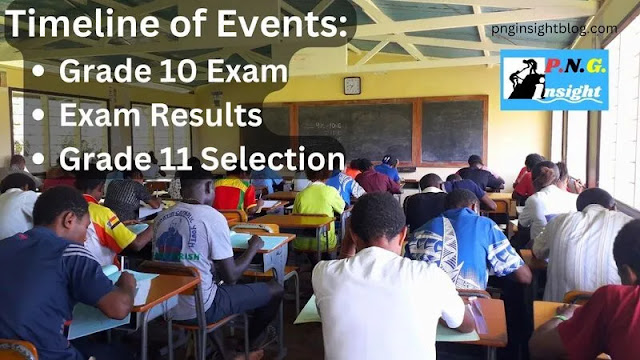
Timeline of Events: Grade 10 Exam Results Release Date, and Grade 11 Selection

Here is a step-by-step timeline of the key events related to the Grade 10 exam results and Grade 11 selection process:

October: National Examinations

  • Grade 10 students across PNG take their national exams in October each year.
  • The week after the exams, selected Grade 10 teachers in each province mark the exams and record the students' scores.
  • Provincial Examination Supervisors (PESs) and provincial marking committees coordinate the making in each province
  • The PES sends the Grade 10 results to the Measurement Services Division of the National Education Department in Port Moresby.
Click here to check out the expected release date of the Grade 11 Selection List by the Education Department.

Grade 11 selection list 2025


November: Data Checks and Release of PNG Grade 10 Exam Results

In November, the Measurement Services Division (MSD) of the Department of Education checks the Grade 10 students' scores to make sure they are accurate.

This is a very important step because it makes sure that the student's information is correct before the results are released to the selections.

Once the MSD has checked the scores, they release the results for Grade 10 students to the Grade 11 selection committee and also publish the results online.


December: Grade 11 Selection

Two key education entities are involved in the Grade 11 selection process: the General Education Services (GES) of the Department of Education, and school principals or provincial representatives.

  • The MSD processes the Grade 10 exam results and makes them available online.
  • The GES and principals use these results to select students for Grade 11.
  • The selection process can take up to two weeks to finish.
  • Once the selection process is finished, the GES publishes the Grade 11 selection list on the Department of Education's website.
Click on the link to get more information about Grade 10 and Grade 12 Selections.


Grade 11 Selection: Weighted-Score System vs. Circumstance


Weighted-Score System

The weighted-score system is the primary method for selecting students for Grade 11 in Papua New Guinea. Students are assigned a weighted score based on their performance on the Grade 10 national exams, with higher scores given to more difficult subjects. Students with the highest weighted scores are selected for Grade 11, regardless of their province or other circumstances.

Watch this video to find out how the Education Department uses this system to select students.


Selection by Circumstance

In addition to the weighted score system, there are several other factors that can influence the selection of students for Grade 11. PNG Insight lists the 5 main factors below.

Academic performance: 

A student's academic performance on the Grade 10 national exams is still a very important factor in the selection process, even if they are selected based on circumstance. 

Number of spaces available: 

There are only a limited number of spaces available in secondary and national high schools.  Students may miss out on selection for Grade 11 even if they do not have the highest weighted scores.

Parental requests: 

Parents and guardians can write to school principals to explain why they want their child to go to a particular school. Principals may consider parental requests when selecting students for Grade 11, but they are not obligated to do so.

Special circumstances: 

In some cases, special circumstances such as family reasons or job transfers may allow principals to select students for Grade 11 at their schools. Principals may consider special circumstances when selecting students for Grade 11, but they are not obligated to do so.

Student preferences: 

Students can indicate their preferences for secondary and national high schools on their School Leavers Forms (SLF). Principals may consider student preferences when selecting students for Grade 11, but they are not obligated to do so.


Significance of the Grade 10 Exam and Grade 11 Selection Process

The Grade 10 exam and Grade 11 selection process is a very important event in the lives of PNG students, parents, and guardians. The outcome of this process determines a student's eligibility to continue their secondary education and pursue their academic dreams.

For students, the Grade 10 exam and Grade 11 selection process is a crucial milestone in their academic journeys. It is a time for them to reflect on their academic progress and set goals for the future. It is also a time for them to seek support from their parents, teachers, and mentors.

For parents and guardians, the Grade 10 exam and Grade 11 selection process is a time of great anticipation and anxiety. They want their children to succeed and have the best possible opportunities for the future. However, they are also aware of the challenges that their children may face in the competitive selection process.


Conclusion

The Grade 10 exam and Grade 11 selection process in Papua New Guinea is a critical event that shapes the academic journeys of students. The transparency and fairness of this process, along with the dedication of educational authorities, ensure that deserving students receive the opportunities they need to achieve their goals in life.


------

Disclaimer

This information is based on PNG Insight's in-depth understanding of the exam process and workings of the education department's exams and selection process over the years. We are not affiliated with the education department, nor do we represent the department.

The education department does not publish the exact date for the release of the exam results and the Grade 11 selection list in the Education Calendar. It only announces the date when the results and selection lists are ready. That means that you will have to depend on news, social media, and PNG education website for the latest on Grade 10 (and Grade 8 and 12) results and selection.

Please note that this information is for informational purposes only and is not intended to be a substitute for official information from the education department.

POST A COMMENT.

SEARCH THE ENTIRE SITE HERE

Public Holidays in PNG 2025

Public Holidays in PNG 2025
CLICK ON THE IMAGE TO GET THE LATEST INFORMATION